
Non GamStop Casinos UK 2026 – Guide to Casinos Not on GamStop
Non GamStop casinos exist in a complicated space that makes everyone slightly uncomfortable. They’re online gambling sites operating outside the UK’s GamStop self-exclusion scheme, which means UK players who’ve self-excluded can still access them. Whether that’s a safety valve for people who made impulsive decisions they regret or a dangerous loophole enabling self-destructive behavior depends entirely on who’s using them and why.
This guide explains what casinos not on GamStop actually are, why some UK players seek them out, and the significant risks involved alongside any potential benefits. We’re not here to promote offshore gambling or encourage anyone to bypass self-exclusion – honestly, if you’re reading this because you’re trying to get around a block you put in place because gambling was causing harm, you probably already know deep down that this isn’t going to end well.
Instead, we’re providing honest, balanced information for people who are already considering this option or want to understand the landscape. If you’re in crisis mode, looking for ways to gamble despite self-excluding because you couldn’t handle it, please pause here. Resources like GamCare - and the National Gambling Helpline (0808 8020 133) offer genuine support without judgment. They’ve heard it all before, and they’re not there to lecture you.



Best Casinos Not on Gamstop in 2026
Looking for casinos not on GamStop in 2026 feels a bit like navigating a regulatory grey area, which is precisely what you’re doing. The big-name UK casinos everyone talks about? They’re on GamStop, which is why you’re here. We’ve researched and evaluated numerous non-GamStop casinos to identify which ones offer legitimate licensing, reasonable safety standards, and decent player experiences.
And here’s the reality: most of them are mediocre at best. Several were genuinely frustrating – slow verification processes, clunky interfaces, customer support that takes days to respond with generic answers that don’t address your actual question. But a few stood out as relatively reputable operators that at least meet basic standards for offshore casinos.
Here are the ones that cleared the minimum bar for 2026:
Combined Comparison Table
| Casino | Gambling Licence | Welcome Bonus | Accepted Payment Methods | Verification Type | Payout Speed |
|---|---|---|---|---|---|
| Allspins Casino | Curaçao eGaming | 100% up to £300 + 100 Free Spins | Debit cards, Skrill, Neteller, bank transfer, cryptocurrencies | Standard KYC (ID + proof of address) | 24-48 hours after verification |
| Casino Joy | Curaçao eGaming | 200% up to €1,000 (spread across multiple deposits) | Debit cards, Skrill, Neteller, bank transfer, cryptocurrencies | Standard KYC (ID + proof of address + sometimes selfie verification) | 48-72 hours after verification |
| Fat Pirate Casino | Curaçao eGaming | €10 Free Bonus + 25 Free Spins (No Deposit) | Debit cards, e-wallets (Skrill, Neteller), bank transfer, cryptocurrencies | Standard KYC (ID + proof of address + proof of payment method) | 72 hours – 5 days after verification |
| Winner Casino | Costa Rica | 150% up to €300 (spread across multiple deposits) | Debit cards, credit cards, e-wallets, bank transfer, cryptocurrencies | Standard KYC (ID + proof of address), can take 48-72 hours for approval | 48-72 hours after verification (up to 5 days for bank transfers) |
| Monster Casino | Curaçao eGaming | 100% up to £100 + 50 Free Spins | Debit cards, Skrill, Neteller, MuchBetter, bank transfer | Standard KYC (ID + proof of address) | 48 hours after verification |
| BetMorph | UK Gambling Commission (UKGC) | 100% up to £50 (split between sports & casino) | Debit cards, PayPal, Skrill, Neteller, bank transfer | Standard KYC (ID + proof of address) | 24-48 hours after verification |
| Midnite Casino | UK Gambling Commission (UKGC) | 100% up to £100 + 50 Free Spins | Debit cards, PayPal, Skrill, Neteller, Trustly | Standard KYC (ID + proof of address, sometimes proof of payment method) | 24-72 hours after verification |
| Duelz Casino | Malta Gaming Authority (MGA) & UK Gambling Commission (UKGC) | 100% up to £100 + 100 Free Spins | Debit cards, Skrill, Neteller, Trustly, MuchBetter, bank transfer | Standard KYC (ID + proof of address), additional verification for larger withdrawals | 24-48 hours after verification (can be faster with e-wallets) |
| SpinYoo Casino | Curaçao eGaming | 100% up to £500 + 100 Free Spins | Debit cards, Skrill, Neteller, MuchBetter, bank transfer, cryptocurrencies | Standard KYC (ID + proof of address + proof of payment method) | 48-72 hours after verification (faster with crypto) |
| All British Casino | UK Gambling Commission (UKGC) | 100% up to £100 | Debit cards, PayPal, Skrill, Neteller, Paysafecard, bank transfer | Standard KYC (ID + proof of address), sometimes required before first deposit | 24-48 hours after verification (often faster with PayPal) |
Quick Non Gamstop Casinos Reviews
Allspins Casino
Allspins Casino - Review allspins is a straightforward slots-focused site that doesn’t try to be anything other than what it is-a place to spin reels. The game library is extensive with most major providers represented, including all the football slots you’d want to play. The site design is clean without being flashy, and navigation is intuitive enough that you won’t get lost trying to find what you’re looking for. It’s not going to win any awards for innovation, but sometimes you just want a casino that works without unnecessary complications.
The welcome bonus is generous, though the 50x wagering requirement is on the steep side and will take some serious grinding to clear. Withdrawals are processed reasonably quickly once you’re verified, though the verification process itself can be a bit slow. If you’re after a no-nonsense slots site with a solid game selection and don’t mind the higher wagering requirements, Allspins does the job.
Pro: Extensive slots library with all major providers and football-themed games
Con: High wagering requirements (50x) make bonus difficult to clear

- Large selection of slots and table games
- Generous welcome bonuses
- No verification needed at registration
Casino Joy
Casino Joy - Review casino joy has a bright, cheerful design that either feels welcoming or slightly childish depending on your taste. The game selection is solid with a good mix of slots, table games, and live dealer options. They’ve got most of the popular football slots including several from NetEnt and Yggdrasil. The site runs smoothly on mobile, and the interface is genuinely user-friendly, which makes a difference when you’re trying to navigate between games quickly.
The welcome bonus package is spread across multiple deposits, which means you need to deposit several times to claim the full amount. Some players like this structure, others find it annoying. Customer support is generally responsive, though they tend to push bonus offers a bit too aggressively for my liking. If you can ignore the constant promotional emails, it’s a decent site with a good game selection.
Pro: User-friendly interface that works smoothly on both desktop and mobile
Con: Welcome bonus spread across multiple deposits requires several transactions to claim fully
- Over 3,000 slots from big-name providers
- Fast deposits and same-day e-wallet withdrawals
- Frequent bonuses and cashback offers
- Easy account setup with no KYC at registration for most countries
- Mobile site loads quickly and runs smoothly
Fat Pirate Casino
Fat Pirate Casino - Review fat pirate casino commits fully to the pirate theme with treasure maps, skull imagery, and nautical references throughout. It’s either charming or obnoxious depending on how much you enjoy themed casinos. The game library is surprisingly comprehensive with providers like Microgaming and NetEnt well represented. Navigation can be a bit clunky-the pirate theme sometimes gets in the way of actual usability-but once you figure out where everything is, it works fine.
The welcome bonus combines cash and free spins, which gives you flexibility in how you use it. The 60x wagering requirement is genuinely high though, and you’ll feel it when you’re trying to clear the bonus. Withdrawal times are average for a Curaçao-licensed casino-expect around 3-5 days for bank transfers, faster for e-wallets. If you can get past the heavy-handed theming and steep wagering requirements, there’s a decent casino underneath.
Pro: Comprehensive game library including hard-to-find Microgaming titles
Con: Very high wagering requirements (60x) and sometimes clunky navigation
- Fantastic and coherent user interface and thematic display
- Diverse game catalogue.
- Rewarding bonuses for newbies and returning players.
- Crypto and fiat payments.
- Responsive support options.
Winner Casino
Winner Casino - Review winner casinohas been around since 2009, which gives it a bit of credibility in an industry where operators come and go constantly. The site operates under a Costa Rica licence, which isn’t the strongest regulatory framework, but they’ve built a reputation for actually paying out winnings without too much drama. The game selection is massive with over 2,000 slots from multiple providers, including all the football-themed options you’d expect.
The welcome bonus is distributed over several deposits with a total value that looks impressive on paper but requires commitment to claim fully. Verification can take longer here than at UKGC-licensed sites-budget at least 48-72 hours for document approval. The interface feels a bit dated compared to newer casinos, but it’s functional and everything works as it should. If you’re comfortable with a Costa Rica licence and want access to a huge game library, Winner Casino is worth considering.
Pro: Massive game library with over 2,000 slots and long-standing reputation since 2009
Con: Costa Rica licence offers less regulatory protection than UKGC or MGA licences
- Welcome bonus for newbies
- Mobile adaptability
Monster Casino

Monster Casino leans into a cartoon monster theme that’s more playful than scary. The site design is modern and well-executed, with the monster characters adding personality without getting in the way of usability. The game selection includes all the major providers and most of the football slots mentioned in this guide. One thing I appreciated is that the bonus terms are laid out more clearly than most casinos-you’re not hunting through five different pages to find the wagering requirements.
The welcome bonus is decent without being extraordinary, and the wagering requirements sit at a reasonable 35x. Withdrawal processing is fairly quick at around 48 hours after verification, which is acceptable. The main downside is that the playful theme might not appeal to everyone-if you prefer a more serious, professional casino aesthetic, the cartoon monsters might grate on you. But if you can get past that, it’s a solid operator with transparent terms and good game selection.
Pro: Clear, easy-to-find bonus terms and transparent wagering requirements
Con: Playful cartoon theme may not appeal to players wanting a more professional casino aesthetic
BetMorph

BetMorph positions itself as a sportsbook-first operator with a casino section that feels like it was added as an afterthought. The sports betting side is actually quite good with competitive odds and a decent range of markets, but if you’re specifically after football slots or a comprehensive casino experience, you might feel a bit shortchanged. The site design is clean and modern, though navigating between sports and casino can be slightly clunky.
The welcome bonus is split between sports and casino, which sounds good in theory but means you’re getting less for each section than you would at a dedicated casino or sportsbook. Still, if you want both under one roof and don’t mind the casino selection being smaller, it does the job. Withdrawals are reasonably quick once you’re verified, which is always appreciated.
Pro: Strong sportsbook with competitive odds and good market coverage
Con: Limited casino game selection compared to dedicated casino sites
Midnite Casino

Midnite Casino has a slightly edgy, nighttime vibe that either works for you or feels a bit try-hard depending on your mood. The game selection is solid with most major providers represented, and they’ve got a decent chunk of football slots including several from Pragmatic Play and Yggdrasil. The site runs smoothly on mobile, which matters since most people are playing on their phones these days anyway.
The welcome bonus is fairly standard for the UK market-nothing spectacular but not insulting either. One thing I noticed is that customer support can be slow during off-peak hours, which is frustrating if you run into issues with verification or withdrawals. But when they do respond, they’re generally helpful and sort things out properly.
Pro: Good selection of football slots from major providers like Pragmatic Play and Yggdrasil
Con: Customer support response times can be slow outside peak hours
Duelz Casino
Duelz Casino built its reputation on tournaments and competitive play between users, which adds a social element you don’t usually get at online casinos. The tournament feature actually works well if you’re into that sort of thing-racing against other players to complete challenges or hit certain win thresholds. The game library is extensive with pretty much every football slot you’d want to play, and the site design is modern without being overwhelming.
The downside is that the focus on tournaments and gamification might feel gimmicky if you just want to spin slots without the extra noise. The welcome bonus comes with fairly standard wagering requirements, and withdrawals are processed reasonably quickly once you’ve jumped through the verification hoops. It’s a solid choice if the tournament aspect appeals to you, less so if you prefer a straightforward casino experience.
Pro: Unique tournament system adds competitive element and extra engagement
Con: Heavy focus on gamification and tournaments might feel gimmicky for traditional players
SpinYoo Casino

SpinYoo Casino is one of those sites that does a bit of everything without necessarily excelling at any one thing. The slot selection is massive with over 3,000 games from what feels like every provider under the sun, including all the football slots mentioned in this guide. The interface is straightforward and easy to navigate, which is more than you can say for some casinos that overcomplicate things with flashy animations and confusing menus.
The welcome bonus is generous on paper, but the wagering requirements are on the higher end at 40x, which makes it harder to actually clear and withdraw anything. Verification can also take longer than you’d like-budget at least 48 hours for document approval before your withdrawal processes. But if you’re after pure variety in game selection and don’t mind the slightly slower withdrawal times, SpinYoo delivers on that front.
Pro: Massive game selection with over 3,000 slots from multiple providers
Con: Higher wagering requirements (40x) and slower verification process
All British Casino

All British Casino does exactly what it says on the tin-it’s a UK-focused operator with a proper British theme that doesn’t feel forced or patronizing. The site has been around since 2013, which is practically ancient in online casino terms, and they’ve built a solid reputation for reliability and fair play. The game selection includes all the major football slots you’d expect, and they regularly update their library with new releases.
The welcome bonus is more modest than some competitors, but the wagering requirements are lower at 30x, which makes it more realistic to actually clear and withdraw something. Customer support is genuinely helpful and UK-based, which makes a difference when you need something sorted quickly. The main downside is that the site design feels a bit dated compared to newer casino-it’s functional but not particularly exciting. Still, if you value reliability and decent customer service over flashy design, All British Casino is a safe bet.
Pro: Lower wagering requirements (30x) and UK-based customer support
Con: Site design feels dated compared to newer casino operators
Important caveats before you get excited:
None of these casinos offer the same player protections as UKGC-licensed sites. They’re the better options within the non-GamStop space, but “better” is relative. You’re still gambling at offshore sites without UK regulatory oversight. Currency conversion fees, slower dispute resolution, and less robust responsible gambling tools remain issues even at these “good” options.
If you’re considering these casinos specifically because you’re trying to bypass self-exclusion you put in place due to gambling problems, please reconsider whether this is genuinely a good decision. These sites being accessible doesn’t mean using them will end well. The fact that they’re not on GamStop is a feature for some players and a dangerous loophole for others – be honest with yourself about which category you actually fall into.
2026 has seen incremental improvements in the non-GamStop space as competition forces operators to improve standards slightly. But “improved” doesn’t mean “safe” or “recommended without reservation.” These casinos represent the least problematic options available if you’ve decided to gamble at non-GamStop sites despite the risks. Whether that decision itself is sound depends entirely on your circumstances and motivations.
What is GamStop?
GamStop is the UK’s national self-exclusion scheme for online gambling. Launched in 2018, it allows people to voluntarily ban themselves from all UK Gambling Commission (UKGC) licensed online gambling sites with a single registration. It’s essentially a big red button that locks you out of every legitimate UK gambling site simultaneously.
When you register with GamStop, you choose an exclusion period – 6 months, 1 year, or 5 years. During that time, all UKGC-licensed casinos, betting sites, bingo halls, and poker rooms must block your access. The scheme is free to use and covers over 400 licensed operators.
GamStop by the numbers:
As of 2024, over 530,000 UK residents have registered with GamStop since its launch – that’s roughly 1% of UK adults. The majority choose the 5-year exclusion period, which tells you something important. People aren’t using GamStop for casual “maybe I should take a break” decisions. They’re using it when gambling has become genuinely problematic and they need serious intervention.
The scheme works well within its scope. If you’re self-excluded and try to access a UK-licensed gambling site, you’re blocked. Operators face heavy fines if they allow self-excluded players through, so they take it seriously. The problem – if you view it as a problem – is that GamStop only covers UK-licensed sites. International gambling sites operating under foreign licenses aren’t part of the scheme and can legally accept UK players who’ve self-excluded domestically. Which brings us to why you’re reading this article.
What Are Non-GamStop Casinos?
Non GamStop casinos are online gambling sites that operate without a UK Gambling Commission license. Instead, they hold licenses from foreign regulatory bodies like the Malta Gaming Authority (MGA), Curacao eGaming, Gibraltar Gambling Commission, or others. Some hold licenses that are essentially worthless pieces of paper from “regulators” that barely exist.
Because these casinos aren’t UKGC-licensed, they’re not required to participate in GamStop. This means UK players who’ve self-excluded can still register and gamble at these sites. Whether the casinos should accept self-excluded UK players is ethically questionable – and frankly, most of them know exactly what they’re doing when they advertise “no GamStop” as a feature rather than a bug.
Important distinction: “Not on GamStop” doesn’t automatically mean “unregulated” or “illegal,” although plenty of gambling sites not on GamStop do fall into those categories. Reputable casinos not on GamStop hold legitimate licenses from recognized authorities. They’re just not licensed by the UKGC specifically, which means they can operate outside UK rules.
However, it also doesn’t mean they’re as safe or well-regulated as UK sites. Foreign gambling licenses vary dramatically in strictness. An MGA license involves rigorous oversight comparable to the UKGC. A Curacao license is… well, let’s just say the bar is significantly lower. Some “licenses” are essentially purchased certificates from jurisdictions that will license anyone with a payment processor and a website.
Why Do UK Players Choose Gambling Sites Not on GamStop?
People seek out non GamStop sites for various reasons, and it’s worth being honest about the full spectrum rather than pretending everyone has noble motivations:
- Regretted self-exclusion: Some players register with GamStop impulsively during a bad losing streak, after a partner’s ultimatum, or in a moment of clarity that fades when the urge to gamble returns. The minimum 6-month exclusion feels excessive when you’ve convinced yourself you can handle it now. This is the most sympathetic reason, although it’s worth questioning whether that “I can handle it” feeling is accurate or just your brain rationalizing.
- Frustration with UK restrictions: UKGC regulations have tightened considerably, and not everyone struggling with gambling appreciates being treated like they need protection. The 2020 credit card ban, strict affordability checks, limited bonuses, mandatory session timers, and spin speed restrictions frustrate recreational players who feel over-regulated. Some of these frustrations are valid – the regulations can feel patronizing if you genuinely gamble responsibly.
- Better bonuses and promotions: Non GamStop casinos often offer larger welcome bonuses and ongoing promotions than UK sites, which face strict advertising and bonus restrictions. For players chasing value, offshore sites look significantly more attractive. A 300% deposit match beats a 100% match, simple maths.
- Payment method preferences: UK sites can’t accept credit cards for gambling since April 2020, which was probably necessary but annoying for people who use credit responsibly. Many gambling sites not on GamStop still accept credit cards and offer cryptocurrency options, appealing to players wanting these methods. The crypto angle particularly attracts people who value privacy or just think Bitcoin gambling is cool.
- Game selection: Some international game providers and progressive jackpots aren’t available at UK-licensed sites due to regulatory requirements or provider choices. Non GamStop casinos may offer games you can’t find elsewhere, which matters if you have favorites.
- Privacy concerns: UKGC sites must conduct affordability checks and can request bank statements, payslips, and other financial documents if you’re winning or depositing amounts they deem suspicious. Some players find this intrusive – and honestly, being asked to prove you can afford your own money does feel a bit Big Brother. Offshore sites typically skip this scrutiny.
- Problem gambling relapse: And here’s the uncomfortable truth – some people seek non GamStop sites specifically because they’re struggling with gambling addiction and looking for ways to continue despite knowing they shouldn’t. They’re not researching offshore casinos out of curiosity or legitimate frustration with regulations. They’re desperately searching for any site that will let them gamble, and “non GamStop” is the search term that gets them there.
That last category is why this entire topic sits in such an uncomfortable ethical space. If you’re in that category, you already know it. This article isn’t going to change your mind – addiction doesn’t work that way – but please know that bypassing GamStop when you have a genuine gambling problem typically makes things significantly worse, not better.
Pros and Cons of Playing at Non-GamStop Casinos
Advantages of Non-GamStop Sites
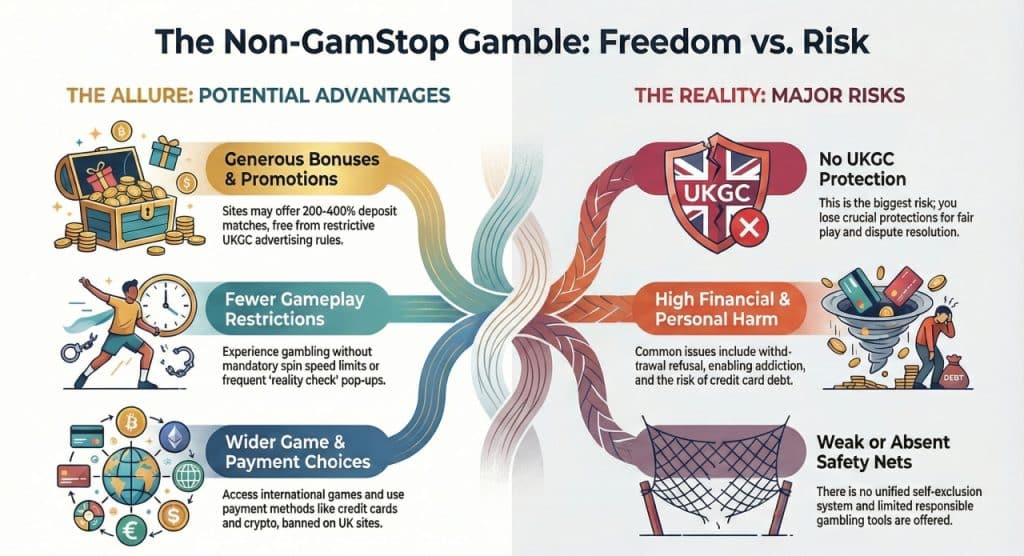
- Higher bonuses and promotions: Without UKGC restrictions on advertising and bonus terms, non GamStop casinos often offer 200%, 300%, or even 400% deposit matches alongside generous free spins packages. The wagering requirements might be astronomical too, but the headline offers look impressive enough to tempt you. Whether you can actually clear a 60x wagering requirement is a different question.
- Broader game selection: Access to international slots, live dealer games, and progressive jackpots that might not be available at UK sites. Some players particularly value crypto-based provably fair games unavailable at UKGC casinos, or just want access to specific titles they enjoy.
- More payment options: Credit cards, debit cards, cryptocurrencies, and various e-wallets that UK sites can’t offer. This flexibility appeals to players with specific payment preferences or those who value the anonymity of crypto. It also appeals to people who shouldn’t be gambling on credit but will anyway.
- Fewer restrictions: No spin speed limits, no mandatory session reminders every 30 minutes, no pop-ups asking if you’re sure you want to continue. For recreational players who find UK regulations overbearing and infantilizing, this feels like being treated as an adult who can make their own decisions.
- Accessibility for self-excluded players: If you genuinely regret self-excluding during a moment of panic and believe you can now gamble responsibly, non GamStop sites provide access. Whether this is actually an advantage or a dangerous temptation depends entirely on whether your self-assessment of “I can handle it now” is accurate or just what you’ve convinced yourself.
- Potentially better odds on some games: Some offshore sites offer games with slightly higher RTPs than their UK-licensed equivalents, although this varies significantly by operator and game. You’ll need to do research rather than just trusting their claims.
Drawbacks & Risks to Consider
- No UKGC protection: This is the massive one that outweighs almost everything else. UK gambling regulations exist for good reasons – player protection, fair gaming, responsible advertising, dispute resolution, verified RNGs. Casinos not on GamStop don’t follow these rules. If something goes wrong, you have far less recourse. You’re basically gambling in the regulatory Wild West and hoping everyone plays fair.
- Variable licensing standards: An MGA or Gibraltar license offers decent protection and genuine oversight. A Curacao license offers minimal oversight and questionable enforcement. Some non GamStop sites claim to be “licensed” by authorities that are essentially just websites selling certificates to anyone who pays. Distinguishing legitimate licenses from worthless ones requires research most players don’t bother doing.
- Withdrawal problems: Horror stories about non GamStop casinos refusing withdrawals, imposing unfair terms after you’ve won, demanding excessive verification documents, or simply disappearing with player funds are disturbingly common. Not every offshore casino is a scam, but the risk is significantly higher than with UKGC sites, and you have minimal recourse when it happens.
- Currency conversion issues: Many non GamStop sites operate in euros or dollars. Currency conversion fees and unfavorable exchange rates can quietly eat into your bankroll and any winnings. You win £500 but only receive £460 after conversions and fees – it adds up.
- No unified self-exclusion: If you decide you need to stop, there’s no single system to block access to all non GamStop sites. You’d need to self-exclude from each individually, and many don’t offer proper self-exclusion tools. Good luck maintaining that discipline when you’re in the grip of wanting to gamble.
- Enabling problem gambling: If you’re using non GamStop sites specifically to bypass self-exclusion you put in place because gambling was causing genuine harm, you’re almost certainly making your situation worse. The temporary relief of being able to gamble again typically leads to more losses, more problems, and deeper holes to dig yourself out of. We both know how this story usually ends.
- Credit card debt risk: The ability to use credit cards at gambling sites not on GamStop can quickly snowball into serious debt. UK banned this for very good reasons – gambling on credit is a express route to financial disaster for vulnerable players. Just because offshore sites allow it doesn’t mean the consequences disappear.
- Limited or no support services: UKGC sites must provide links to support organizations and offer tools like reality checks and deposit limits. Many non GamStop sites offer minimal responsible gambling tools, if any. Some have a perfunctory “gamble responsibly” link buried in their footer, and that’s it.
- Potential legal grey areas: While it’s not illegal for UK players to use offshore casinos, you’re gambling in a regulatory grey area. Tax implications, legal protections, and dispute resolution all become more complicated. Most players won’t face issues, but “probably fine” isn’t the same as “definitely protected.”
How to Choose a Safe Casino Not on GamStop
If you’ve decided to use non GamStop casinos despite the risks – and let’s be honest, if you’ve read this far you’ve probably already decided – at least choose operators that offer some level of safety and legitimacy:
Check Licensing & Regulation (MGA, Curacao, etc.)
Verify the license actually exists: Look for the license number on the casino’s footer, then check it against the regulator’s official registry. This takes five minutes and can save you from obvious scams. Some sites display fake license logos or claim licenses they don’t hold, betting you won’t bother checking.
Understand license quality hierarchy:
- Top tier: Malta Gaming Authority (MGA), UK Gambling Commission (though these are on GamStop obviously), Gibraltar Gambling Commission
- Mid tier: Curacao eGaming, Kahnawake Gaming Commission
- Questionable: Various obscure “licensing authorities” that offer minimal oversight and exist primarily to collect licensing fees
Even a Curacao license is better than no license at all, but recognize it doesn’t provide the same protection as stricter regulators. It’s more of a participation certificate than a guarantee of quality.
Read Player Reviews & Reputation
Check independent review sites, forums, and communities like AskGamblers, Trustpilot, or Reddit gambling communities. Look for patterns in complaints – every casino gets some negative reviews from sore losers or bonus abusers, but consistent reports of withheld withdrawals or unfair terms are massive red flags.
Pay attention to how long the casino has operated. A site that’s been around for five years with generally positive feedback is safer than a brand-new operation with no track record and a suspiciously generous welcome bonus. New casinos aren’t automatically scams, but they’re higher risk.
Look for Secure Payments & Support
SSL encryption: The site should use HTTPS and display security certificates. This is absolute bare minimum basic security, but you’d be surprised how many dodgy sites skip it.
Recognized payment processors: If the casino uses established payment providers like Skrill, Neteller, or reputable cryptocurrency processors, those companies have done some vetting. Casinos using only obscure payment methods you’ve never heard of should raise serious concerns.
Responsive customer support: Test the support before depositing. Ask questions via live chat or email and evaluate response times and helpfulness. Casinos with poor support before you’ve deposited definitely won’t help when you have serious problems after depositing.
Use Personal Limits & Protection Tools
Even if the casino doesn’t enforce strict responsible gambling measures, impose your own – because nobody else will:
Set deposit limits: Decide in advance how much you can afford to lose and stick to it. Write it down. Tell someone you trust. Make it a real commitment, not just a vague intention you’ll ignore the first time you’re on a losing streak.
Use gambling blocking software: Apps like GamBan or BetBlocker can block access to gambling sites across all your devices. If you’re at risk of losing control – and be honest with yourself about this – these add a barrier between you and poor decisions at 2am when your judgment is compromised.
Set time limits: Decide how long you’ll play and use timers or reminders to enforce breaks. Gambling for hours without interruption clouds judgment and makes it easier to chase losses past your limits.
Never gamble with credit: Just because non GamStop sites accept credit cards doesn’t mean you should use them. Credit card gambling is a terrible idea that leads to debt you can’t afford. If you can’t afford to gamble with money you actually have, you definitely can’t afford to gamble with borrowed money.
Game Selection & Software on Non-GamStop Sites
Gambling sites not on GamStop often feature games from international providers that UK players might not encounter at UKGC sites. You’ll typically find:
Online Slots - Online slots: Hundreds or thousands of titles from providers like NetEnt, Microgaming, Pragmatic Play, and others. Some non GamStop sites also feature lesser-known international providers not common at UK casinos – which could mean hidden gems or could mean dodgy games with questionable RTPs.
Live dealer games: Evolution Gaming, Ezugi, and other live casino providers operate at many offshore sites. Quality varies dramatically, but top-tier non GamStop casinos offer live experiences comparable to UK sites. Lower-tier ones might have laggy streams, unprofessional dealers, or suspiciously frequent dealer wins.
Table games: Blackjack, roulette, baccarat, and poker variants in both RNG and live formats. Standard stuff, although verify the RTPs if you care about getting fair odds.
Progressive jackpots: Access to major networks like Mega Moolah, although availability depends on the specific casino and its provider agreements. Some jackpots are restricted to certain jurisdictions, so you might not have access to everything.
Sports betting and esports: Many casinos not on GamStop also offer sportsbooks, sometimes with more betting markets than UK equivalents. Particularly common for esports betting, which some UK sites still treat as a niche oddity.
Crypto-exclusive games: Provably fair games using blockchain technology for transparency. These aren’t available at traditional UK casinos and appeal to crypto enthusiasts or people who just like the mathematical verifiability aspect.
The trade-off is that not all games are created equal. RTP percentages, game fairness, and provider legitimacy vary more at non GamStop sites than at UKGC casinos where everything must meet strict standards. That “96% RTP” claim might be accurate or might be completely fabricated – you’re trusting the casino’s word without independent verification.
Payment Options at Casinos Not on GamStop
Non GamStop sites typically offer broader payment options than UK casinos, although this flexibility comes with risks that aren’t immediately obvious:
Credit and debit cards: Visa and Mastercard are commonly accepted, unlike at UK sites where credit cards are banned for gambling. Convenient if you use credit responsibly, absolutely catastrophic if you don’t. The UK banned credit card gambling specifically because too many people were gambling themselves into serious debt, and that risk hasn’t disappeared just because you’re using an offshore site.
E-wallets: Skrill, Neteller, PayPal (sometimes), and others work at many gambling sites not on GamStop. These add a layer between your bank and the casino, which provides some financial separation and makes it slightly harder to deposit impulsively.
Bank transfers: Direct bank transfers are available but typically slow for both deposits and withdrawals. Deposits might take days to process, withdrawals even longer. Not ideal if you’re impatient or prefer instant gratification.
Cryptocurrencies: Bitcoin, Ethereum, Litecoin, and other cryptos are increasingly popular at non GamStop casinos. They offer anonymity and fast transactions but come with volatility risk – your £100 deposit might be worth £95 or £105 by the time you cash out depending on crypto market swings – and learning curves if you’re not already crypto-familiar.
Prepaid cards: Paysafecard and similar prepaid options help limit spending since you can only deposit what you’ve loaded onto the card. This is actually one of the safer payment methods if you’re worried about overspending.
Payment considerations:
Check fees before depositing – seriously, actually check. Some non GamStop sites charge deposit or withdrawal fees that aren’t advertised prominently, and currency conversion can add unexpected costs. What looks like a fee-free transaction might cost you 3-5% after conversions and processing fees.
Withdrawal times vary dramatically – e-wallets might process in hours, bank transfers could take a week or more. Some sites deliberately slow-walk withdrawals hoping you’ll reverse them and gamble your winnings away. If a casino takes more than 48 hours to process a withdrawal, that’s a red flag.
Be wary of minimum withdrawal amounts and maximum withdrawal limits. Some sites impose high minimums (must withdraw at least £100, which is annoying if you’ve only won £75) or cap withdrawals (maximum £5,000 per month, which doesn’t matter to most players but can trap your funds if you hit a big win).
Responsible Gambling on Non-GamStop Sites
Using casinos not on GamStop requires significantly more personal responsibility than gambling at regulated UK sites, because the external protections are weaker or absent entirely. You’re essentially gambling on the honor system with yourself.
GamStop vs GamBan vs GamBlock: Which Blocking Tool Actually Works?
If you’re trying to regain control over gambling – whether you’re using non-GamStop sites or want to block everything – understanding the differences between blocking tools matters. Here’s the honest comparison:
GamStop is the UK’s free national self-exclusion scheme, but it only blocks UKGC-licensed sites. That’s its fundamental limitation – it’s excellent at what it covers but useless for non-GamStop casinos, which is presumably why you’re reading this article. Once you register, you’re locked out of all UK-licensed gambling sites for your chosen period (6 months, 1 year, or 5 years). There’s no circumventing it without committing fraud, which is its strength. The weakness is that it does absolutely nothing about offshore sites, making it ineffective if you’re determined to find alternatives.
GamBan - Not on gamban is paid blocking software (around £20-30 for a multi-device annual license) that blocks access to tens of thousands of gambling sites worldwide across all your devices – phones, tablets, computers. It covers UK-licensed sites, non-GamStop casinos, cryptocurrency gambling sites, and most online betting. The software is aggressive and comprehensive, blocking sites even if you’ve never heard of them. The advantage is that it actually blocks non-GamStop casinos effectively, updating its database constantly as new sites appear. The disadvantage is that it costs money (although let’s be honest, if you’re gambling hundreds or thousands, £30/year is trivial), and it only works if you don’t uninstall it. There’s a time-delay feature that prevents immediate removal, but if you’re determined enough, you can work around it eventually. It’s very effective for people who genuinely want to stop but struggle with impulse control.
GamBlock - is similar to GamBan – paid blocking software that works across devices and blocks gambling sites comprehensively. It costs roughly the same (£30-50 annually depending on coverage). The main difference is implementation details and device compatibility. Some users find GamBlock more robust on Windows computers, others prefer GamBan’s mobile experience. Functionally, they’re comparable – both block non-GamStop sites effectively, both can be circumvented if you’re determined, both work better than trying to maintain discipline through willpower alone.
The uncomfortable truth: All three tools – GamStop, GamBan, and GamBlock – only work if you actually want them to work. GamStop can’t be easily bypassed (hence this entire article about non-GamStop sites existing). GamBan and GamBlock can be uninstalled if you’re determined enough, although the time-delay features and device admin requirements make it harder than just deleting an app.
Which should you use?
- If you’re gambling only at UK sites: GamStop is free and bulletproof. Use it.
- If you’re using non-GamStop sites and genuinely want to stop: GamBan or GamBlock. Pick one based on device compatibility and reviews. The cost difference is negligible. Both work well if you commit to not uninstalling them.
- If you’re trying to protect yourself from future temptation: Use all three. Register with GamStop for UK sites, install GamBan or GamBlock for everything else. Redundancy helps when willpower fails at 2am.
- If you’re reading this thinking “but I could just uninstall the blocking software”: You’re right, you could. The question is whether you actually want to stop gambling or just want to feel like you’re doing something about it whilst maintaining access. Be honest with yourself about which category you’re in.
The blocking software isn’t magic. It’s a tool that creates friction between you and gambling sites. That friction is sometimes enough to break the impulse cycle – you want to gamble, you try to access a site, it’s blocked, the moment passes, you do something else. Sometimes the friction isn’t enough and you’ll find ways around it. But creating obstacles is better than pretending willpower alone will work when it hasn’t worked so far.
Setting Limits and Self-Exclusion Alternatives
Personal deposit limits: Even if the casino doesn’t enforce them, set your own strict limits on how much you’ll deposit per day, week, or month. Write them down somewhere you’ll actually see them. Tell someone you trust what your limits are – external accountability helps when your brain is rationalizing “just one more deposit.”
Loss limits: Decide in advance how much you’re willing to lose in a session, day, or week. When you hit that limit, stop. Not “stop after this next hand” or “stop after I try to win some back.” Just stop. This sounds simple but it’s remarkably difficult when you’re actually in the moment with a balance of zero and the itch to deposit again.
Time limits: Gambling for hours without breaks clouds judgment and makes chasing losses feel more reasonable than it actually is. Set timers for 30-minute or 1-hour sessions with mandatory breaks where you step away from the screen entirely.
GamBan and BetBlocker: These software applications block access to gambling sites across all your devices. If you’re worried about losing control – and you should be honest with yourself about this risk – install one before temptation strikes, not after. GamBan costs money but is comprehensive and effective. BetBlocker is free and works well enough for most people.
Re-register with GamStop: If you bypassed GamStop and now realize gambling is again becoming problematic, you can register again. There’s no judgment, no penalty, no “you already used your chance” restriction. The scheme exists to help, and you can use it as many times as needed. Nobody’s keeping score except your bank account.
Individual casino self-exclusion: Many reputable non GamStop casinos offer their own self-exclusion options. Use them if you need to step back from specific sites, although recognize this only works if you actually follow through and don’t just find another casino five minutes later.
Recognizing Problem Gambling Signs
Gambling becomes a problem when it starts causing harm to yourself or others. You probably already know the warning signs, but here they are spelled out:
- Chasing losses: Continuing to gamble trying to win back money you’ve lost, often with increasing desperation and larger bets that you’ve convinced yourself are “due to hit.” The math doesn’t work that way, but your brain keeps insisting it does.
- Lying about gambling: Hiding how much you’re gambling or lying to family and friends about losses. If you’re deleting transaction notifications from your phone or explaining away missing money with creative stories, you already know there’s a problem.
- Neglecting responsibilities: Missing work, ignoring family obligations, or letting bills go unpaid because you’re gambling or don’t have money left after gambling. When gambling takes priority over actual necessities, it’s crossed the line from entertainment to problem.
- Borrowing money to gamble: Taking loans, using credit cards, or asking friends and family for money to fund gambling. Once you’re gambling with borrowed money – whether from banks, payday lenders, or people you know – things typically escalate quickly from bad to significantly worse.
- Feeling anxious or irritable when not gambling: Gambling to escape problems or relieve negative moods, and feeling uncomfortable when you can’t access gambling. If gambling has become your primary coping mechanism for stress, boredom, or negative emotions, that’s a red flag.
- Gambling with money you can’t afford to lose: Using rent money, bill money, or funds meant for necessities on gambling. The classic sign things have gone seriously wrong.
- Unable to stop despite wanting to: Trying to cut back or quit but finding yourself unable to maintain the boundary. You set limits and break them. You promise yourself you’ll stop and don’t. The gap between intention and action keeps widening.
If you recognize these patterns in yourself – and genuinely, honestly recognize them rather than acknowledging them intellectually whilst convincing yourself you’re the exception – please reach out for help:
- GamCare: Free, confidential support via phone (0808 8020 133), live chat, or forums at www.gamcare.org.uk -
- National Gambling Helpline: 0808 8020 133 (24/7)
- Gamblers Anonymous: Peer support groups across the UK, find meetings at www.gamblersanonymous.org.uk -
- BeGambleAware: Information and support at www.begambleaware.org -
These organizations exist to help without judgment. The people who work there and attend GA meetings have heard everything before. Reaching out isn’t admitting failure – it’s taking control of a situation before it gets worse. Which it will, if left unchecked.
FAQs
-
Are non-GamStop casinos legal for UK players?
It’s not illegal for UK players to gamble at overseas casinos not on GamStop. The legal issue falls on unlicensed operators targeting UK players without UKGC authorization, not on the players themselves. However, these sites operate outside UK regulation, meaning you have significantly less legal protection if disputes arise. It’s legal but carries risks that UK-licensed sites don’t.
-
Can I self-exclude from casinos not on GamStop?
They’re not part of the GamStop scheme, so registering with GamStop won’t block them – that’s rather the point. Some individual non GamStop sites offer their own self-exclusion, but there’s no unified system and quality varies dramatically. Your best options are using gambling blocking software like GamBan or BetBlocker, which work across multiple sites, or manually self-excluding from each casino separately and hoping you have the discipline to not just find another one.
-
Do non-GamStop casinos accept credit cards or crypto payments?
Often yes. Unlike UK sites (which banned credit cards in April 2020), many gambling sites not on GamStop still accept credit and debit cards. Cryptocurrencies like Bitcoin are also commonly available. However, using credit to gamble is extremely risky and can quickly lead to unmanageable debt. Just because they accept it doesn’t mean you should use it – UK banned credit card gambling for very good reasons.
-
How can I identify a reputable non-GamStop casino?
Look for a valid license from a recognized authority – Malta Gaming Authority is the gold standard for offshore sites, Gibraltar is good, Curacao is acceptable but less rigorous. Check the license number against the regulator’s official registry rather than just trusting the logo on the site. Read independent player reviews on sites like AskGamblers or Trustpilot, looking for patterns of complaints. Verify the casino uses SSL encryption and recognized payment processors. Test customer support responsiveness before depositing. If something feels off or too good to be true, trust that instinct rather than convincing yourself you’re just being paranoid.
-
Why would someone use a non-GamStop casino instead of a UK-licensed site?
Reasons vary widely: some players genuinely regret impulsive self-exclusion and feel they can now gamble responsibly (whether that’s accurate is debatable); others want access to payment methods or games not available at UK sites; some prefer the larger bonuses and fewer restrictions at offshore casinos; and unfortunately, some are struggling with problem gambling and desperately searching for any site that will let them continue despite self-exclusion. The motivations range from reasonable to deeply concerning depending on individual circumstances and honesty about those circumstances.
-
What happens if a non-GamStop casino refuses to pay my winnings?
This is one of the major risks that makes the whole enterprise questionable. If the casino holds a legitimate license from MGA, Gibraltar, or similar reputable authority, you can file a complaint with their regulator, though the process is slower and less player-friendly than UKGC complaints. If they hold a weak license or no license, your options are extremely limited. You might pursue a chargeback through your payment provider, but success isn’t guaranteed and some casinos ban you for even attempting it. This is why choosing reputable, well-licensed casinos matters – the risk of non-payment is significantly higher at dodgy operators, and you’ll have minimal recourse when it happens.
-
Can UK banks block transactions to non-GamStop casinos?
Some UK banks have started blocking transactions to unlicensed gambling sites as part of responsible banking initiatives. This isn’t universal, but it’s becoming more common. If your bank blocks a transaction, it’s worth considering whether that’s a sign you shouldn’t be using that site rather than just an inconvenience to work around. Banks implement these blocks to protect customers from scams and problem gambling, not to arbitrarily limit your freedom.
-
Are winnings from non-GamStop casinos taxable in the UK?
UK law doesn’t tax gambling winnings, regardless of where you win them. This is one of the few straightforward answers in this entire topic. However, tax law is complex and if you’re winning substantial amounts regularly – which is statistically unlikely but possible – consulting a tax advisor is wise to ensure you’re handling everything correctly. Most casual players won’t have tax issues, but professional or high-stakes gamblers should seek professional advice rather than just assuming.
Conclusion
Key Takeaways for UK Players
Non GamStop casinos exist in a complicated regulatory space that makes almost everyone slightly uncomfortable, for good reasons. They’re not illegal for UK players to use, but they operate outside the protections and restrictions of UK gambling law. For some players, they offer a legitimate alternative with more freedom, better bonuses, and access to games or payment methods unavailable at UKGC sites. For others – particularly those who self-excluded due to problem gambling – they represent a dangerous loophole that enables continued harm whilst providing a veneer of legitimacy.
The quality and safety of casinos not on GamStop vary dramatically from “mostly fine” to “outright scam.” Reputable sites licensed by authorities like Malta or Gibraltar offer reasonable security and fair gaming. Dodgy operations with questionable licenses or no licenses at all can disappear with your money, and you’ll have minimal recourse beyond posting angry reviews that nobody reads. Research thoroughly before depositing anywhere, and recognize that even “good” non-GamStop sites don’t offer the same protections as UK-licensed operators.
If you’re considering non GamStop sites specifically to bypass self-exclusion you imposed because gambling was causing genuine problems, please pause and reconsider. The issues that led you to self-exclude haven’t magically disappeared. Bypassing GamStop typically leads to more losses, more problems, and deeper holes to dig yourself out of. You already know this if you’re honest with yourself. Support services like GamCare and Gamblers Anonymous exist to help, and there’s genuinely no shame in using them – only in pretending you don’t need them whilst things get progressively worse.
Balancing Freedom and Responsible Play
For players who genuinely regret impulsive self-exclusion and honestly believe they can gamble responsibly at gambling sites not on GamStop, the key is imposing your own strict boundaries and actually maintaining them. Set deposit limits and stick to them even when you’re convinced “just this once” won’t hurt. Use gambling blocking software if you’re worried about losing control – install it before you need it, not after. Never gamble with money you can’t afford to lose, and absolutely never gamble on credit regardless of how tempting those available credit card deposits look.
Remember that UK gambling regulations exist for good reasons, even when they feel patronizing or excessive. They protect vulnerable people, ensure fair gaming, and provide recourse when things go wrong. Choosing to gamble at non GamStop casinos means accepting significantly more personal risk and responsibility. You’re betting that you can maintain control and that the casino will play fair, with limited protection if either assumption proves wrong.
If gambling stops being entertainment and starts causing stress, financial problems, or relationship issues, it’s time to step back. Re-register with GamStop, use blocking software, or reach out to support services. There’s no prize for pushing through when gambling is causing harm – only escalating consequences that get harder to fix the longer you wait.
Ultimately, whether casinos not on GamStop are a reasonable alternative or a dangerous temptation depends entirely on your individual circumstances, motivations, and ability to maintain control. Be honest with yourself about which category you actually fall into, not which category you’d prefer to fall into. Your financial and mental wellbeing are worth more than any bonus, any game, or the temporary relief of being able to gamble again.